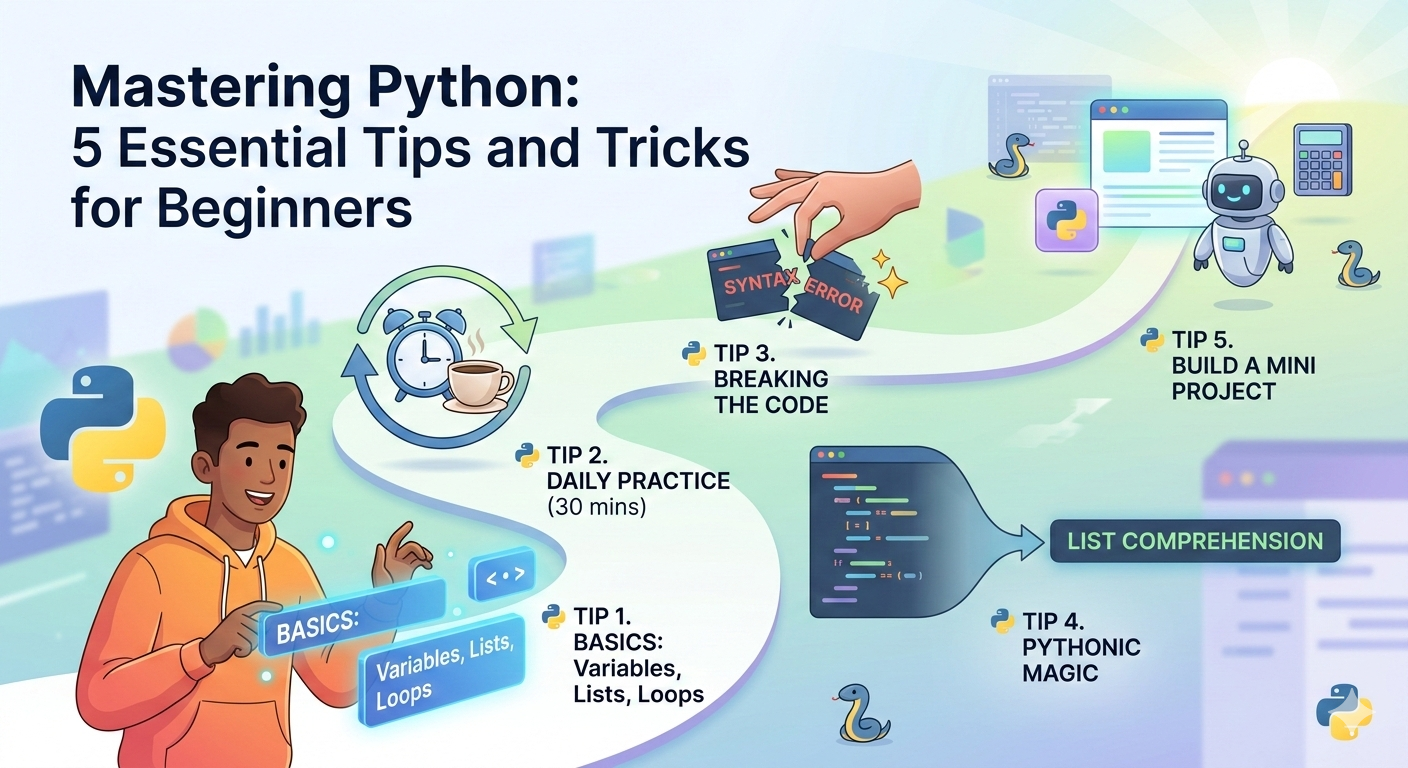
Starting your journey into the world of programming can feel overwhelming, but choosing Python is the best first step you can take. Known for its readability and versatility, Python is the “human-friendly” language of the tech world. Whether you aim to dive into Data Science, Web Development, or Automation, here are 5 essential tips and tricks to fast-track your Python learning process.
1. Master the Fundamentals (The “Lego” Bricks)
Before jumping into complex Artificial Intelligence or building the next big web app, you must understand the core building blocks. Python’s syntax is clean, but the logic behind it is universal.
Focus your first two weeks on:
-
Variables and Data Types: Learn how Python handles strings (text), integers, floats, and booleans.
-
Data Structures: This is where the magic happens. Master Lists for ordered data, Dictionaries for key-value pairs, and Sets for unique items.
-
Control Flow: Understand how to make decisions in your code using
if-elsestatements and how to repeat tasks usingforandwhileloops.
Pro Tip: Don’t just memorize syntax. Try to explain why a dictionary is better than a list for storing a user’s profile.
2. Write Code Every Day (Consistency Over Intensity)
Coding is a “muscle memory” skill, much like learning a musical instrument or a new spoken language. If you stop practicing, you start forgetting.
It is much more effective to practice for 30 minutes every day than to pull a 10-hour coding marathon once a week.
-
The 24-Hour Rule: Try to touch your code within 24 hours of learning a new concept.
-
Interactive Platforms: Use sites like HackerRank, Codewars, or LeetCode to solve small logic puzzles. These gamified platforms keep you motivated.
3. Don’t Just Read, “Break” the Code
One common mistake beginners make is “Tutorial Hell”—watching hours of videos without ever typing a line of code. When you follow a tutorial, don’t just copy-paste. Intentional breaking is the best way to learn.
-
Change the variables.
-
Delete a colon or change the indentation.
-
Modify the logic to see what happens.
Understanding Error Messages is 50% of a programmer’s job. When you see a SyntaxError, IndentationError, or TypeError, don’t panic. Read the message carefully; Python is literally telling you where the problem is.
4. Use Pythonic “Magic” (List Comprehension)
As you move past the absolute basics, you’ll want to write code that looks professional. In the community, we call this being “Pythonic.” One of the best tricks to achieve this is List Comprehension.
5. Build a Mini Project Immediately
Theory will only take you so far. The “aha!” moment usually happens when you build something that actually works. You don’t need to build a complex engine; start with scripts that solve a tiny problem in your life.
Beginner Project Ideas:
-
A Personal Finance Tracker: A script that calculates your monthly expenses.
-
An Automated File Organizer: A script that moves your “Downloads” files into folders based on their extension (.jpg, .pdf, .docx).
-
Simple Games: Build a “Rock, Paper, Scissors” game or a “Guess the Number” bot.
